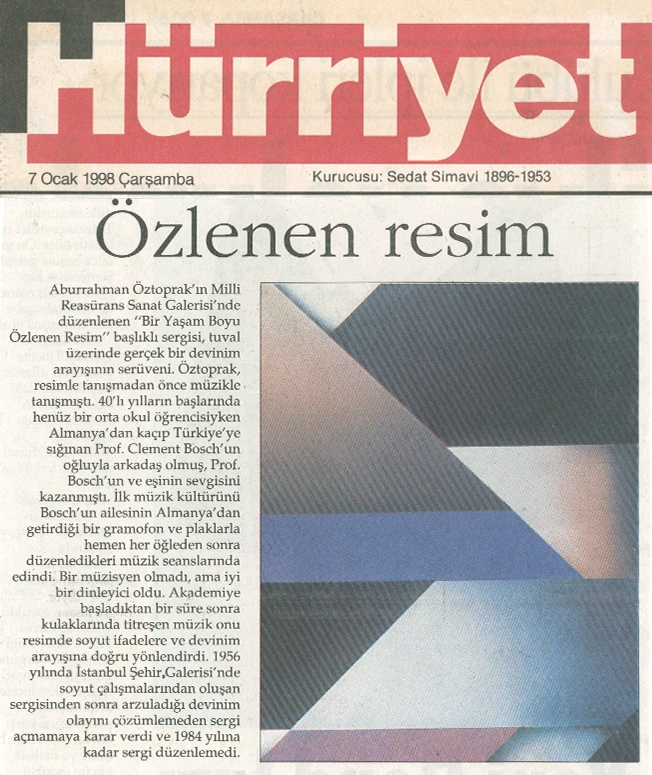
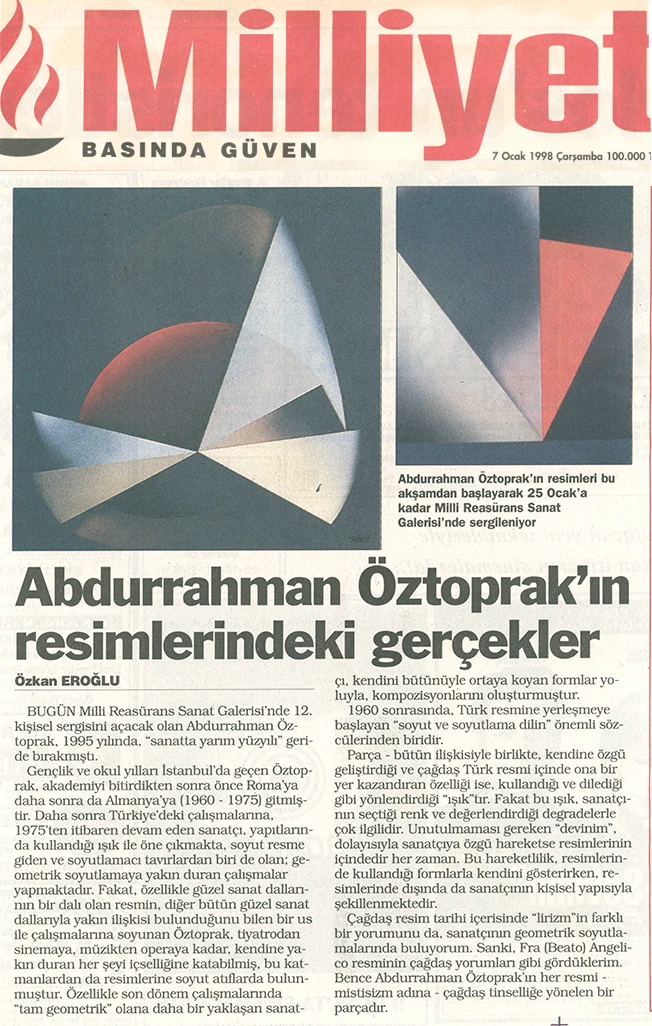
Throughout the 1960s, he traveled through cities such as Paris, Brussels, Antwerp, and Amsterdam in search of this desired sense of movement. He conducted extensive studies. In 1967, at an exhibition in Darmstadt, he encountered a small 21 x 11 cm plaster panel by Paul Klee, executed in watercolor on a gold ground, which pointed him toward the solution he had long been seeking. In 1968, his exposure to kinetic sculptures at an exhibition in Kassel opened up new sources of inspiration. In these works, movement was achieved mechanically and with auxiliary materials, and was dependent on the space they occupied. Öztoprak, however, sought to create movement on canvas, independent of space and through conventional painting techniques. What followed was an intense and demanding period of exploration. When he finally opened his exhibition in 1984 at the Moda Sea Club in Istanbul, he had achieved the “true movement” he had long sought—successfully translating the music resonating within him onto the canvas.
A student of Nurullah Berk at the Academy of Fine Arts, Öztoprak later studied fresco at the Academy of Fine Arts in Rome. In 1954, he received an honorable mention in the “Production” themed competition organized by Yapı Kredi Bank. In 1955, he produced three paintings representing the province of Kars for the new building of the Turkish Grand National Assembly. In 1956, he was awarded in the State Painting and Sculpture Competition. Between 1960 and 1975, he lived in Germany, where he worked as an interior architect.
Abdurrahman Öztoprak’s exhibition was on view at the Millî Reasürans Art Gallery between January 7 and January 25, 1998.